










Lip Filler Migration: Why It Happens and How to Fix It
Learn why lip filler migration happens, how to recognize the signs, distinguish it from swelling and explore safe treatment options.

- Last updated
- 19 reads
- 6 min read
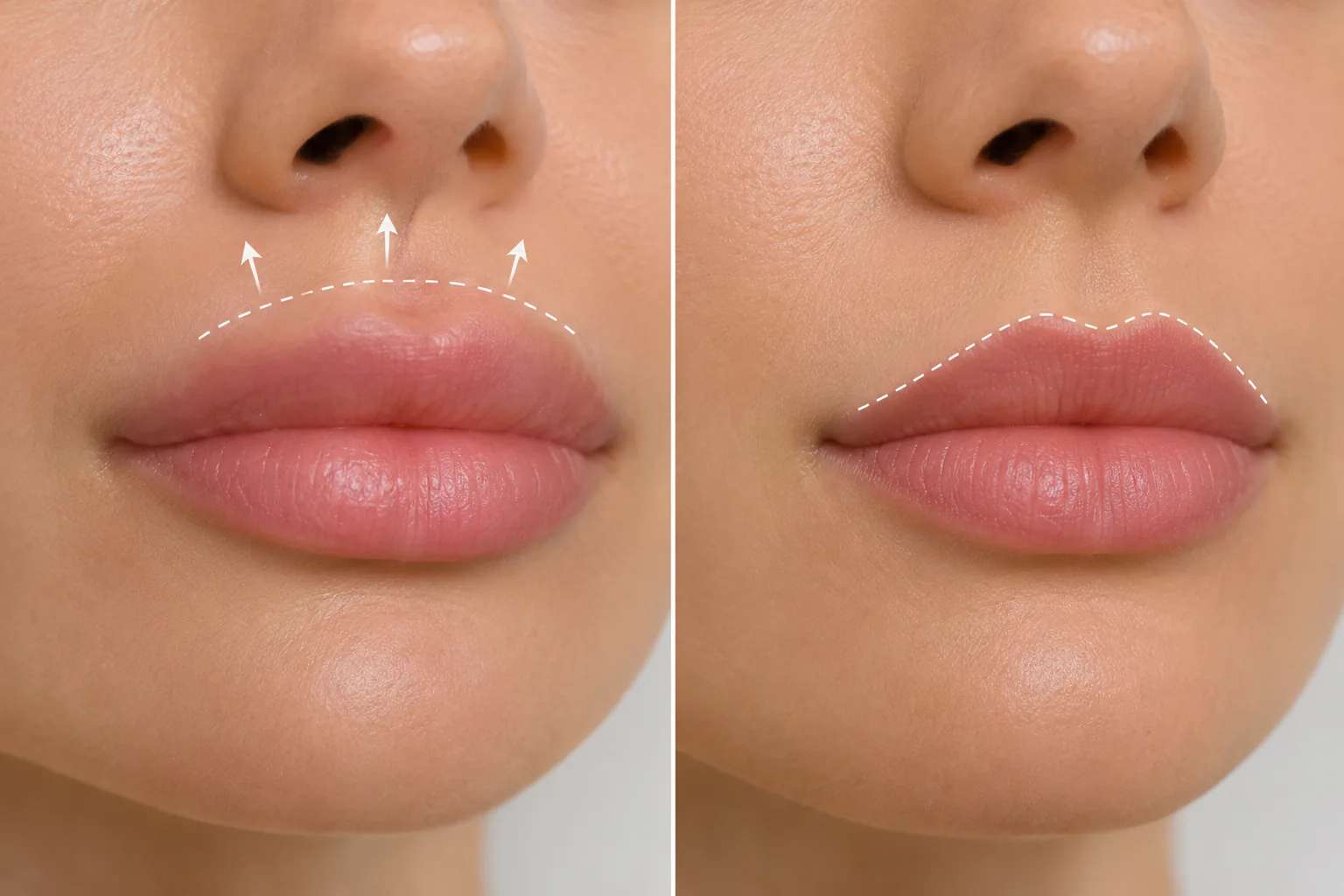


Fuller lips, a more defined Cupid's bow and balanced facial proportions are often the reasons people consider lip fillers. But sometimes, the results begin to change in unexpected ways. The upper lip may appear unusually prominent, a ridge may develop above the natural lip line, or the lips may gradually lose their original definition.
These changes may be associated with lip filler migration. Although the condition has received considerable attention on social media, it is more than just an aesthetic trend. Knowing how to recognize migrated filler, distinguish it from temporary swelling and understand the available correction options can help you make more informed decisions about your next treatment.
What Does Lip Filler Migration Look Like?
Lip filler migration occurs when injected filler moves beyond the area where it was originally placed. Instead of remaining within the intended lip tissue, the material may extend into surrounding areas, affecting the shape and definition of the mouth.
Migration can be subtle, particularly in its early stages. In other cases, changes become increasingly noticeable after repeated treatments.
Common signs of possible lip filler migration include:
-
A raised ridge above the upper lip.
-
Loss of definition around the Cupid's bow.
-
Excessive projection when viewed from the side.
-
Fullness between the upper lip and nose.
-
Persistent lumps or uneven contours.
-
A blurred natural lip border.
However, these signs do not automatically confirm migration. Incorrect initial placement, excessive filler and prolonged swelling can produce similar results.
Why Does Lip Filler Migrate?
The lips are constantly moving. Speaking, eating, smiling and other facial expressions involve a complex network of muscles and soft tissues. This makes lip augmentation particularly dependent on appropriate product selection and precise placement.
Several factors may contribute to filler migration.
Too Much Filler
The lips have limited space to accommodate additional volume. Excessive amounts of filler may distort their natural boundaries and create unwanted fullness in surrounding tissues.
Frequent Top-Up Appointments
The visible effects of filler may diminish before the injected material has completely broken down.
Receiving additional injections without assessing previously treated areas can lead to accumulated volume and altered lip proportions.
Incorrect Filler Placement
The depth and location of injections influence the final appearance. Filler placed outside the appropriate anatomical layer may create irregular contours or contribute to displacement.
Unsuitable Filler Type
Dermal fillers differ in their firmness, flexibility and ability to retain water. Products designed to provide structural support in the cheeks may not be suitable for the softer, more mobile tissues of the lips.
Lip Filler Migration vs Swelling: How Can You Tell the Difference?
Looking in the mirror shortly after a lip filler appointment can be misleading. Temporary swelling may make the lips appear larger, less defined or more uneven than expected.
The main difference is how the appearance changes over time.
| Normal lip filler swelling | Possible lip filler migration |
|---|---|
| Usually develops shortly after injections | May become noticeable weeks or months later |
| Gradually improves during recovery | May persist after swelling resolves |
| Can cause temporary asymmetry | May create lasting contour irregularities |
| Often involves mild tenderness | May be completely painless |
| Usually affects the treated area | May extend beyond the natural lip border |
Initial swelling generally improves considerably within the first several days, although the lips may take several weeks to settle fully.
If you have recently undergone treatment, our guide on when swelling goes down after lip filler explains the recovery timeline and when persistent symptoms require further assessment.
What Is a Lip Filler Mustache?
One of the most recognizable appearances associated with migrated lip filler is commonly called a filler mustache.
The term describes a raised area or shadow above the upper lip that makes the natural lip border appear less distinct.
It often becomes more noticeable in side-profile photographs or under certain lighting conditions.
Although frequently associated with migration, a filler mustache can also develop when too much product is initially placed near or beyond the lip border.
The distinction matters because treating excessive volume may require a different approach from correcting displaced filler.
Can Lip Filler Migrate Months or Years Later?
Unwanted changes in lip shape do not always develop immediately after treatment.
Some people notice irregularities months or even years after their first injections, particularly if they have undergone multiple filler appointments.
Previously injected material, additional volume and natural changes in facial anatomy may all contribute to an altered appearance.
However, noticing a change years later does not necessarily mean the filler has recently moved. An existing irregularity may simply have become more visible over time.
A detailed treatment history can help identify the likely cause.
Does Migrated Lip Filler Go Away on Its Own?
Most modern lip fillers contain hyaluronic acid, a substance that the body gradually breaks down.
In some cases, unwanted fullness may decrease as the filler naturally degrades. However, there is no guaranteed timeline for migrated filler to disappear completely.
The amount of product, its composition, injection location and previous treatment history may influence how long the material remains.
For mild aesthetic concerns without medical complications, waiting may be an option following professional assessment.
Our article Does Lip Filler Dissolve on Its Own? explains how natural filler breakdown works and when additional intervention may be necessary.
How to Fix Lip Filler Migration
Correcting migrated lip filler begins with understanding whether the unwanted appearance is caused by displaced material, excessive volume, swelling or another complication.
Dissolving Lip Filler With Hyaluronidase
Hyaluronidase is an injectable enzyme that breaks down hyaluronic acid filler. It may be used to reduce unwanted volume and address certain filler-related irregularities.
Depending on the location and extent of the problem, a medical professional may recommend partial or more extensive dissolution.
However, dissolving filler is not completely risk-free. Temporary swelling, bruising, excessive volume loss and allergic reactions may occur. More than one treatment may also be necessary.
Hyaluronidase does not dissolve every type of dermal filler, and its use for cosmetic filler dissolution is off-label in the United States.
For more information about corrective treatments, read our guide on why people are dissolving their fillers.
Ultrasound-Guided Assessment
When several previous filler treatments make it difficult to determine where the product is located, ultrasound imaging may provide additional information.
High-frequency ultrasound can help identify filler deposits and support more targeted corrective treatment.
It may be particularly useful when the patient has persistent lumps, an uncertain treatment history or unwanted volume extending beyond the lips.
Can You Fix Migrated Lip Filler Without Dissolving It?
Waiting for natural degradation may be appropriate in selected cases. However, there is no reliable at-home method for moving migrated filler back into the lips.
Facial exercises, aggressive massage, heating devices and supplements cannot predictably correct displaced filler.
Adding more filler to disguise an existing irregularity may also increase unwanted volume.
Before attempting any correction, it is important to establish whether the concern is genuine migration or another condition that requires different management.
Five Ways to Reduce the Risk of Lip Filler Migration
Although no injection technique can completely eliminate the possibility of migration, careful planning can help reduce avoidable risks.
-
Choose a qualified medical practitioner experienced in lip anatomy.
-
Avoid excessive augmentation in a single appointment.
-
Have existing filler assessed before scheduling another treatment.
-
Allow adequate time for healing before requesting additional injections.
-
Follow professional aftercare recommendations and avoid unnecessary manipulation of the lips.
For practical recovery recommendations, explore our lip filler aftercare guide.
When Is Lip Filler Migration a Medical Concern?
Migration itself is often an aesthetic issue. However, other filler-related complications may require urgent intervention.
Severe or increasing pain, unusual skin discoloration, pale or mottled areas, blistering and sudden changes in vision require immediate medical attention. These symptoms may indicate a serious problem with blood circulation.
Increasing redness, warmth, fever or discharge should also be assessed promptly because they may indicate infection.
Do not attempt to manage these symptoms with massage or home remedies.
Sometimes, the Best Lip Filler Treatment Is Less Filler
The growing interest in dissolving fillers reflects a broader conversation about facial proportions and natural-looking results.
When unwanted volume develops, another injection is not necessarily the answer. Sometimes, allowing existing filler to settle or carefully reducing previous augmentation may be more appropriate.
Successful lip enhancement is not simply about achieving greater volume. It is about maintaining definition, natural movement and a shape that complements the surrounding facial features.
Understanding lip filler migration before undergoing treatment can be just as valuable as knowing how to correct it afterward.
- Last updated
- Language
- English
How did you find this article?

Why does Botox wear off so quickly? Discover 7 possible reasons, how long Botox normally lasts and what may affect your results.

What happens when you stop getting Botox? Learn whether wrinkles return, skin begins to sag and your face changes as the effects wear off.
Explore exosome skin treatments, potential benefits, scientific evidence, safety risks and how they compare with salmon DNA and polynucleotides.
Subscribe to the Medifinder newsletter and never miss our latest content.