










Tooth Hurts When Releasing a Bite: Could It Be Cracked?
Pain when releasing a bite can point to a cracked tooth, a high filling, an irritated ligament, or another dental issue. Learn what the pattern means.

- Last updated
- 76 reads
- 6 min read
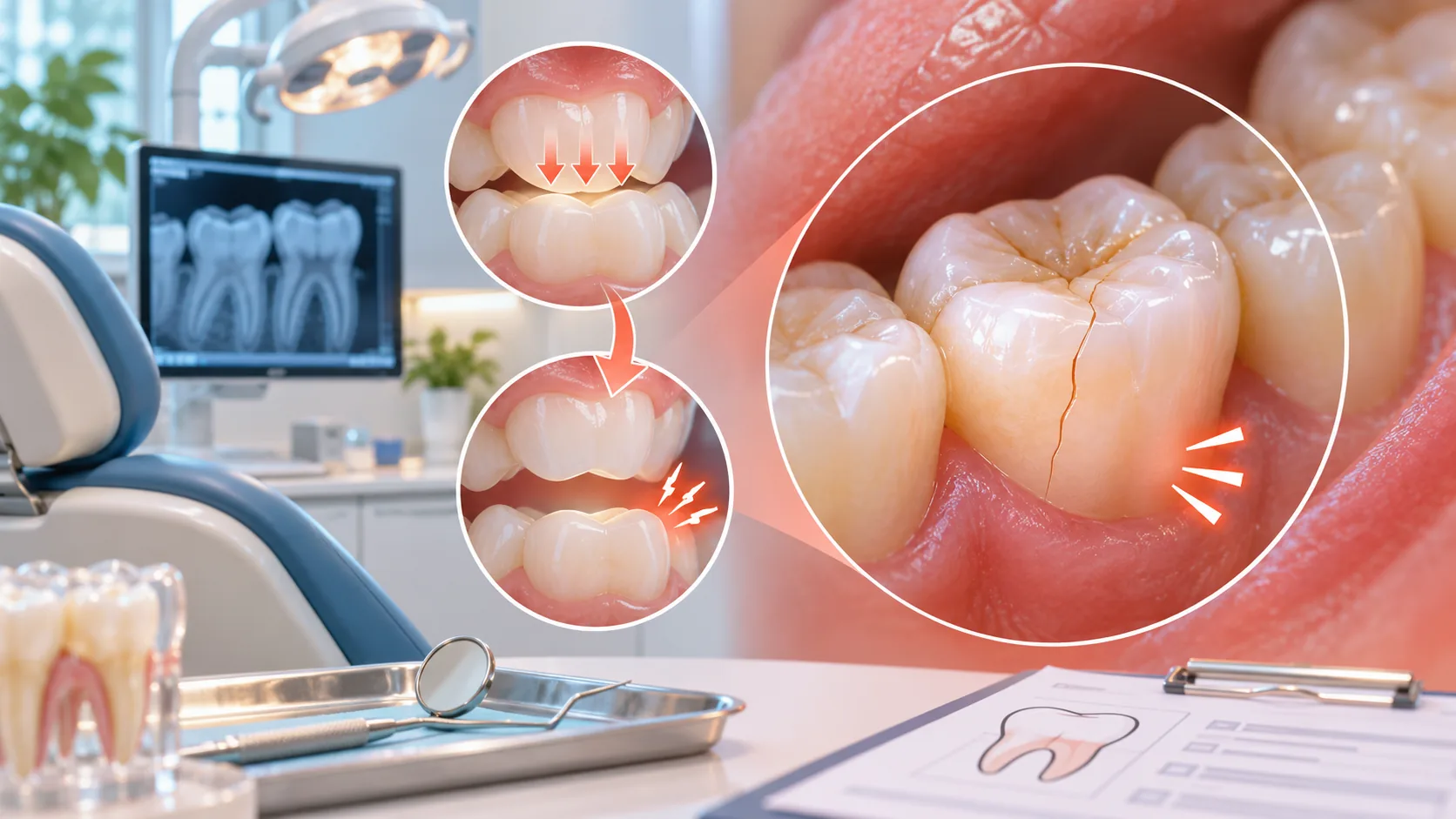


Tooth pain that appears when you release a bite can feel oddly specific. The pressure while chewing may be tolerable, yet the moment the teeth separate brings a sharp twinge. This pattern can occur with a cracked tooth, but it can also result from a high filling, an irritated ligament, gum inflammation, or a problem around the tooth root. The timing of the pain is a useful clue, not a diagnosis by itself.
What Does Pain on Releasing a Bite Feel Like?
People often describe a brief electric jolt, a sharp pinch, or a deep ache that arrives as the tooth springs apart. The tooth may feel tender when chewing hard foods, but the release phase is what makes the symptom memorable. Cold drinks, sweets, or pressure from the tongue may or may not trigger it.
Notice whether the pain is limited to one tooth, whether it happens only at a particular angle, and whether it lingers after the bite. A quick pain that stops immediately is different from a throbbing ache that remains for minutes or hours.
Could a Cracked Tooth Cause Pain on Release?
Yes. A crack can allow part of the tooth to flex under pressure. When the bite is released, the cracked segment may move back, irritating the inner dentin or the pulp. This can create a sudden pain that is difficult to reproduce unless the bite is tested in the right direction.
Cracks are not always visible in a mirror or on a routine dental image. They can begin in the enamel, extend into dentin, or reach the pulp and root. The earlier a symptomatic crack is assessed, the more options may remain for protecting the tooth.
Other Reasons a Tooth Hurts When You Let Go
A High Filling or Crown
If a filling or crown sits slightly high, the tooth may contact first and receive more force than its neighbours. The periodontal ligament around the root can become bruised, making the tooth sore when biting and releasing. The bite may feel uneven or the tooth may feel taller than before.
Irritated Tooth Ligament
Clenching, grinding, chewing ice, or biting something unexpectedly hard can strain the ligament that suspends the tooth. The tooth may be tender to tapping or chewing even when the enamel is intact.
Inflamed Pulp
Deep decay, a large restoration, trauma, or repeated dental work can inflame the pulp. The tooth may react to hot or cold, develop spontaneous pain, or become sensitive to pressure. Release pain can be one part of a broader pattern.
Gum Inflammation or Food Trapping
Food caught between teeth can press on the gum and make biting uncomfortable. Inflamed gum tissue may feel sore when the tooth moves slightly under pressure. Bleeding, swelling, or a bad taste can accompany this cause.
Root or Bone Problems
Infection around the root can make a tooth tender when biting. A pimple on the gum, facial swelling, fever, or a persistent deep ache increases the need for prompt dental care.
- Release pain can occur with a crack, a high restoration, or a bruised ligament.
- Cold sensitivity that lingers may point toward pulp irritation.
- Gum swelling or bleeding suggests a tissue problem around the tooth.
- Facial swelling, fever, or severe constant pain needs prompt care.
How Can You Tell if the Tooth Might Be Cracked?
A cracked tooth may hurt with irregular pressure, such as biting on a seed or a small cotton roll. The pain can be hard to locate and may disappear when you stop chewing. The tooth may have a visible line, but many cracks are hidden under an old filling or along the chewing surface.
Cracks are more likely when the tooth has a large restoration, a history of grinding, repeated fillings, or a recent hard bite. None of these factors proves a crack, but they make the symptom more important to investigate.
Why Does the Pain Happen Only in One Direction?
A crack may open along one axis and remain closed along another. That is why biting on one cusp can hurt while biting on a different part of the tooth feels normal. A dental professional may use a controlled bite test on individual cusps rather than asking you to clench the whole mouth.
Testing the tooth repeatedly at home is not helpful. Hard objects can worsen a crack, and pain can become harder to interpret after repeated pressure.
What Happens During a Dental Examination?
The examination usually includes a history of the pain, visual inspection under magnification, gentle tapping, gum probing, cold testing, and a bite test. Existing fillings, crowns, wear facets, and cracks in nearby teeth are also considered.
Dental images can show decay, bone changes, or root problems, but a crack may not appear clearly. In some cases, the tooth is examined with light transmission, staining, or three dimensional imaging. The goal is to identify whether the pulp, crown, root, or surrounding tissues are involved.
What Should You Do Before the Appointment?
Chew on the opposite side and choose soft foods. Avoid ice, hard nuts, popcorn kernels, sticky sweets, and chewing pens. Keep the area clean with gentle brushing and flossing, but do not force floss into a swollen contact.
- Write down when the pain started and what triggers it.
- Note hot, cold, sweet, and pressure sensitivity.
- Use only pain relief that is safe for you and follow the label.
- Do not place aspirin directly on the gum.
When Is Tooth Pain an Urgent Problem?
Contact a dental service promptly for facial swelling, fever, pus, a bad taste, difficulty opening the mouth, or pain that is rapidly worsening. Emergency care is needed for swelling that affects swallowing or breathing, or for a spreading infection with weakness.
A suspected crack also deserves timely attention even when the pain is brief. Delaying care can allow the crack to deepen, permit bacteria to reach the pulp, or make the tooth harder to restore.
How Is a Cracked Tooth Treated?
Treatment depends on where the crack ends and whether the pulp is healthy. A small surface line may need monitoring or protective restoration. A crack involving a cusp may be stabilized with a bonded restoration or crown. If the pulp is inflamed or infected, root canal treatment may be needed before the tooth is protected.
A crack extending below the gum line may not be restorable. In that situation, the focus shifts to removing the source of infection and planning a replacement. Early evaluation gives the best chance of matching treatment to the actual structure involved.
Frequently Asked Questions About Pain When Releasing a Bite
Does pain when releasing a bite always mean a cracked tooth?
No. A high filling, irritated ligament, gum inflammation, or pulp problem can create a similar sensation. A controlled dental examination is needed to separate these causes.
Can a cracked tooth hurt only when I let go?
Yes. A crack may open as pressure is released, producing a brief sharp pain. The symptom can be intermittent and difficult to reproduce without a focused bite test.
Will a cracked tooth show on an X ray?
Some cracks are visible, but many fine cracks are not. The clinical examination, bite testing, and other imaging or magnification may provide additional information.
Should I keep chewing on the painful tooth to test it?
No. Repeatedly loading the tooth can worsen a crack or irritate the supporting ligament. Use the opposite side until the tooth is assessed.
When should I seek urgent dental care?
Seek prompt care for swelling, fever, pus, severe constant pain, facial spreading, difficulty opening the mouth, or any trouble swallowing or breathing.
Reading the Symptom Without Waiting Too Long
Pain that appears when releasing a bite is a mechanical clue. It may reflect a cracked tooth, but it can also arise from the bite, pulp, gums, or tissues around the root. Protect the tooth from hard pressure, record the pattern, and arrange an examination before a small problem becomes a larger one.
- Last updated
- Language
- English
How did you find this article?
Explore root canal treatment in Turkey, including costs, procedure, recovery time and how to choose an endodontist in Istanbul or Ankara.

Upper dental implants sit near the maxillary sinus. Learn how dental and sinus conditions can overlap, which symptoms matter, and when prompt care is needed.
A temporary crown may last several days to a few months, but its material, bite, seal and condition of the tooth determine how safely it can remain.
Subscribe to the Medifinder newsletter and never miss our latest content.