










Radiesse for Skin Tightening: How It Works?
Radiesse for skin tightening is an injectable treatment that uses calcium hydroxylapatite to encourage collagen formation and improve selected signs of skin laxity, fine wrinkling and reduced tissue firmness.

- Last updated
- 36 reads
- 14 min read
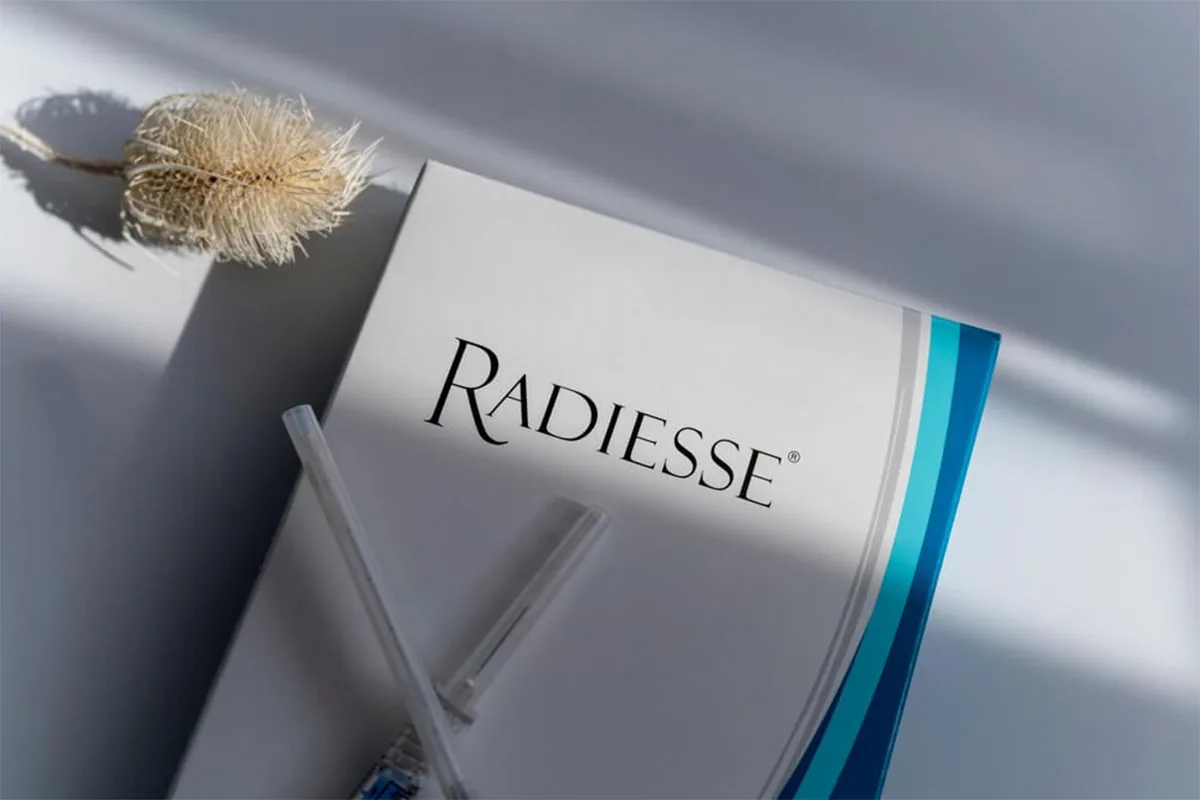


What Is Radiesse for Skin Tightening?
Radiesse is an injectable dermal filler containing calcium hydroxylapatite, a biocompatible substance that can provide structural support while stimulating biological processes involved in collagen formation.
The treatment has two distinct applications. Conventional Radiesse can improve facial contours and selected deeper folds through its immediate filling properties, while diluted formulations may be used to address skin quality across broader areas.
Interest in Radiesse for skin tightening comes primarily from its ability to encourage tissue remodeling after injection. This response may improve the appearance of mildly loose or crepey skin over time.
The procedure does not remove excess skin or reposition facial tissues, so its potential tightening effect should not be confused with surgical lifting.
What Is Calcium Hydroxylapatite?
Calcium hydroxylapatite, commonly abbreviated as CaHA, is a mineral-like compound whose chemical components resemble those found naturally in bones and teeth.
In Radiesse, synthetic CaHA is manufactured as tiny microspheres suspended within a smooth gel carrier. These particles are not harvested from human bones and do not contain living tissue.
The gel helps distribute the microspheres and provides an initial filling effect. As the body gradually absorbs the carrier, the particles remain temporarily within the surrounding tissue, where they interact with cells involved in connective tissue maintenance.
Over time, the body also breaks down the calcium hydroxylapatite particles.
Although Radiesse is not permanent, the structural changes associated with its biological response may remain visible beyond the period of immediate gel-based fullness.
How Does Radiesse Stimulate Collagen and Elastin?
Radiesse stimulates tissue remodeling through the interaction between calcium hydroxylapatite microspheres and the surrounding connective tissue.
Following injection, cells involved in tissue maintenance respond to the presence of the particles. Fibroblasts play an important role because they produce collagen and other components that help maintain skin structure.
Research has also investigated changes in elastin and additional extracellular matrix components after calcium hydroxylapatite treatment.
The formation of new collagen is known as neocollagenesis, while new elastin production is described as neoelastogenesis.
These processes provide a biological explanation for gradual improvements in skin firmness and texture. However, measurable collagen-related activity does not mean that every treatment creates substantial tightening or fully restores the skin's previous structure.
Does Radiesse Tighten Skin or Add Volume?
Radiesse can produce both effects, but the balance between them depends heavily on how the product is prepared and where it is injected.
In its conventional form, the gel carrier provides immediate volume and structural support. This approach may be useful for selected facial folds or areas requiring contour improvement.
When Radiesse is diluted for broader skin-quality treatment, its immediate volumizing effect becomes less prominent, allowing the calcium hydroxylapatite particles to spread through a larger tissue area.
The intended result shifts toward gradual improvement in texture and mild laxity rather than pronounced facial enlargement.
Even when the treatment improves skin firmness, it does not physically lift displaced facial fat or remove loose tissue. Visible tightening is therefore different from the structural correction produced by a facelift.
What Is Hyperdiluted Radiesse?
Hyperdiluted Radiesse is a preparation in which the injectable product is mixed with additional sterile diluent to change its physical characteristics and distribute the CaHA microspheres across a wider area.
The resulting mixture offers less immediate structural volume than conventional Radiesse.
This approach has been investigated for fine wrinkles, crepey texture and mild skin laxity in regions such as the face, neck and décolleté.
Hyperdilution should not be confused with simply weakening the product. The purpose is to alter its distribution and emphasize gradual tissue remodeling rather than concentrated filling.
Importantly, a particular dilution method is not automatically appropriate for every body region. The formulation and technique must correspond to the intended treatment and its supporting safety evidence.
How Is Hyperdiluted Radiesse Different From Standard Radiesse?
Standard Radiesse has a comparatively firm structure that makes it suitable for selected facial contouring and volume-related concerns. Its carrier gel can produce an immediate visible change.
Hyperdiluted Radiesse is distributed more broadly, reducing that initial contouring effect and emphasizing skin-quality improvement over time.
The distinction also affects injection depth and treatment planning. Techniques intended for deeper structural support cannot simply be transferred to superficial skin-quality applications.
For a closer look at the conventional formulation, the guide to Radiesse filler, its uses and longevity explains how calcium hydroxylapatite provides volume while supporting later tissue changes.
Neither approach is universally better. The relevant difference is whether the treatment aims to shape a specific facial feature or improve the appearance of mildly lax skin.
What Skin Concerns May Radiesse Improve?
Radiesse may improve selected skin-quality concerns when the underlying problem involves reduced connective tissue support rather than severe structural sagging.
-
Mild skin laxity: Collagen stimulation may help skin appear firmer in areas with early looseness, although excess skin and pronounced tissue descent remain beyond its corrective capacity.
-
Crepey skin texture: Fine wrinkling and a thin, crinkled appearance may become less noticeable as tissue quality improves following appropriately selected treatment.
-
Décolleté wrinkles: A specifically diluted Radiesse formulation has demonstrated improvement in chest-area wrinkles in controlled clinical research.
-
Reduced facial support: Conventional Radiesse can improve selected folds and contour deficiencies through immediate structural filling combined with subsequent collagen-related changes.
Which Areas Can Be Treated With Radiesse?
Radiesse has established applications for selected facial wrinkles and folds, as well as age-related volume loss on the backs of the hands.
A specific formulation is also authorized in the United States for improving décolleté wrinkles when administered according to its approved dilution and placement instructions.
Diluted or hyperdiluted calcium hydroxylapatite has additionally been investigated for the neck, upper arms, abdomen and other areas with mild skin laxity.
However, published research or professional experience in a particular location does not automatically establish regulatory approval for that use.
The lips and delicate under-eye region are generally unsuitable for routine Radiesse placement because of their anatomy, the product's characteristics and the difficulty of correcting visible irregularities.
Can Radiesse Improve Loose Skin on the Neck?
Hyperdiluted calcium hydroxylapatite has been investigated for improving mild neck laxity and fine, crepey skin changes.
By distributing the microspheres across a broader area, the treatment aims to stimulate tissue remodeling without producing concentrated fullness.
Some published studies and clinical observations suggest improvements in skin texture and firmness, but the evidence is less extensive than for established facial filler applications.
A neck with mild surface wrinkling presents a different problem from one with substantial excess skin, prominent platysmal bands or significant underlying tissue descent.
Radiesse cannot reliably correct all these features through collagen stimulation alone.
In the United States, routine cosmetic neck-tightening treatment with Radiesse should also be distinguished from its specifically approved indications.
Is Radiesse Effective for Décolleté Wrinkles?
Radiesse has demonstrated measurable benefits for selected wrinkles in the décolleté, the upper chest area below the neck.
In a controlled clinical trial, approximately seven in ten treated participants achieved a defined improvement in wrinkle severity at 24 weeks, compared with fewer than one in ten untreated participants.
The studied approach used a specific diluted formulation rather than conventional concentrated filling.
In March 2026, United States regulatory approval was granted for Radiesse diluted at a 1:2 ratio with sterile saline for subdermal correction of décolleté wrinkles in adults aged 22 and older.
This approval is important because it establishes a defined treatment indication and protocol.
However, improvement in chest wrinkles does not establish that Radiesse can remove substantial excess skin or achieve equivalent results across every body area.
Can Radiesse Improve Crepey Skin and Fine Lines?
Crepey skin develops when the surface appears thin, finely wrinkled or less resilient. Age-related changes in connective tissue, sun exposure and variations in skin hydration can all contribute to this appearance.
Calcium hydroxylapatite treatment may improve some of these visible changes by supporting gradual tissue remodeling.
The most relevant improvements tend to involve fine wrinkling, texture and mild firmness rather than deep expression lines.
A forehead crease caused by repeated muscle contraction, for example, has a different origin from fine wrinkles across the décolleté.
Similarly, pronounced sun damage or uneven pigmentation may require treatments that directly address those concerns.
Radiesse should therefore be considered for appropriate tissue-quality changes rather than every type of visible skin aging.
Who Is a Suitable Candidate for Radiesse Skin Tightening?
Radiesse may be relevant for selected adults whose skin concerns correspond to the formulation's intended effects and who understand the limits of injectable tissue remodeling.
-
Adults with early skin laxity: Mild looseness or reduced firmness may respond to collagen stimulation when extensive lifting is not required.
-
People with fine décolleté wrinkles: Those with an appropriate wrinkle pattern may be candidates for the specifically approved diluted treatment.
-
Individuals seeking subtle changes: People who prefer gradual skin-quality improvement without pronounced volume enhancement may find diluted formulations relevant.
-
Adults without significant contraindications: Suitable candidates should not have active infection at the treatment site, known allergy to product components, significant bleeding disorders or other conditions that make injections inappropriate.
How Is a Radiesse Skin Tightening Treatment Performed?
Treatment begins with an assessment of the skin's thickness, degree of laxity, existing wrinkles and the anatomical structures beneath the intended injection area.
The selected Radiesse formulation is prepared according to its intended use. When a diluted protocol is appropriate, the product is mixed under controlled medical conditions before administration.
After cleansing the skin, a qualified medical professional places the material into the designated tissue plane using an appropriate injection technique.
Temporary swelling, tenderness or small injection marks may follow.
The treatment does not require surgical incisions, but correct product preparation and injection depth are essential. Placement that is unsuitable for the area's anatomy can increase the likelihood of visible lumps or more serious complications.
How Many Radiesse Sessions Are Needed?
The number of Radiesse treatments depends on the specific application being considered.
Conventional filler treatment may sometimes achieve its intended structural correction in one appointment, while collagen-focused protocols can involve several sessions.
For the approved diluted décolleté application, clinical research has evaluated treatment courses involving up to three sessions separated by several weeks.
These schedules should not be applied automatically to every hyperdiluted treatment.
Because collagen formation occurs gradually, assessing the result before adding more product is important.
Repeated injections performed too quickly may increase the risk of unnecessary correction, particularly when the tissue response from earlier treatment is still developing.
When Do Radiesse Skin Tightening Results Become Visible?
The timeline depends on whether Radiesse is used primarily for volume or collagen-focused skin-quality improvement.
With conventional Radiesse, the gel carrier can create an immediate contour change, although swelling may temporarily exaggerate the appearance.
Hyperdiluted treatment generally produces less immediate fullness. Improvements in skin texture and firmness may become more noticeable over the following weeks and months as tissue remodeling progresses.
Clinical assessments of diluted décolleté treatment have demonstrated meaningful improvement several months after the treatment course.
A photograph taken immediately after injection may therefore provide little information about the final tightening result.
Comparisons made after swelling settles and the biological response develops offer a more reliable picture of treatment effectiveness.
How Long Do Radiesse Results Last?
Radiesse is biodegradable, but its visible effects can persist beyond the period when the original gel carrier contributes to fullness.
Conventional Radiesse results often remain noticeable for approximately a year, with some selected outcomes lasting longer.
Collagen-focused applications also produce gradual changes, and certain décolleté studies have demonstrated improvements extending beyond twelve months.
However, duration differs between anatomical regions, treatment approaches and measured outcomes.
The presence of new collagen does not mean that the treatment permanently stops aging or prevents further skin laxity.
Maintenance should be considered according to the appearance of the treated area and the evidence supporting the specific application, rather than assuming every Radiesse treatment lasts an identical period.
What Is the Difference Between Radiesse and Sculptra?
Radiesse and Sculptra are both collagen biostimulators, but they contain different materials and produce different immediate effects.
Radiesse uses calcium hydroxylapatite microspheres within a gel carrier, allowing conventional treatment to provide immediate support alongside gradual tissue remodeling.
Sculptra contains poly-L-lactic acid and relies more heavily on a progressive collagen response rather than immediate structural filling.
Both treatments can produce long-lasting changes, but their injection methods, established indications and approaches to correcting complications differ.
Neither material can be predictably dissolved with the enzyme used for hyaluronic acid fillers.
Selecting between them requires identifying whether the main concern involves immediate contour support, gradual volume improvement or more superficial skin-quality changes.
How Does Radiesse Compare With Hyaluronic Acid Skin Boosters?
Radiesse and hyaluronic acid skin boosters may improve skin appearance, but their ingredients and principal mechanisms are different.
Hyaluronic acid skin boosters primarily support hydration by retaining water within the treated tissue. This can make fine dehydration lines and uneven texture less noticeable.
Radiesse relies on calcium hydroxylapatite and is used for structural support or collagen-focused tissue remodeling, depending on the formulation.
The overview of injectable skin boosters and their treatment options provides additional context on hydration-focused alternatives.
A person whose main concern is dryness may not need a collagen biostimulator, while someone with mild laxity may have needs that extend beyond hydration.
The treatments should be compared according to their actual effects, not simply because both involve injections.
Can Radiesse Replace a Facelift or Other Skin Tightening Treatments?
Radiesse cannot reproduce the physical repositioning achieved by a surgical facelift.
Advanced skin laxity often involves excess tissue, altered facial fat compartments and changes in deeper supporting structures. Injectable collagen stimulation may improve skin quality without correcting these underlying changes.
Energy-based procedures, including selected radiofrequency and ultrasound treatments, use different mechanisms intended to influence tissue contraction or remodeling.
Their results should not automatically be considered equivalent to Radiesse either.
For mild texture changes, an injectable approach may offer a reasonable improvement. For substantial tissue descent, comparing treatments solely by the promise of tighter skin can create unrealistic expectations.
The appropriate distinction is between improving tissue quality and physically lifting or removing tissue.
What Are the Side Effects and Risks of Radiesse?
Radiesse carries risks associated with both injectable fillers and the specific behavior of calcium hydroxylapatite within tissue.
-
Temporary injection reactions: Redness, swelling, bruising, tenderness and localized discomfort may occur after treatment, particularly when multiple injection points are used.
-
Lumps and inflammatory changes: Visible or palpable nodules, persistent swelling, asymmetry and delayed inflammatory reactions can develop if the material forms irregular deposits or tissue complications occur.
-
Vascular complications: Accidental injection into a blood vessel can obstruct circulation. Rare but severe consequences include skin necrosis, visual impairment, blindness and stroke.
-
Allergic reactions and infection: People with relevant product sensitivities or certain medical conditions may be unsuitable for treatment. Increasing pain, unusual skin discoloration or visual symptoms following injection require emergency medical attention.
Can Radiesse Be Dissolved or Reversed?
Radiesse cannot be reliably dissolved with hyaluronidase, the enzyme used to break down hyaluronic acid fillers.
This difference is particularly important when unwanted volume, nodules or contour irregularities develop.
Although calcium hydroxylapatite particles gradually break down, the surrounding tissue response may continue contributing to the visible result.
Some complications may improve with observation, while others require medical assessment or additional treatment.
There is no universally reliable method that immediately reverses every undesirable Radiesse outcome.
This limited reversibility makes careful product selection, conservative placement and precise anatomical assessment particularly important before injection.
What Should You Avoid After Radiesse Injections?
After Radiesse treatment, the injection sites may remain temporarily sensitive, making gentle skin care preferable during the initial recovery period.
Forceful rubbing, aggressive massage and unnecessary pressure should be avoided unless the specific treatment instructions recommend controlled manipulation.
Strenuous exercise, excessive heat and sauna exposure may temporarily increase swelling or redness, so short-term activity adjustments can be appropriate.
Strong exfoliating products may also irritate recently treated skin.
Aftercare recommendations for diluted skin-quality applications may differ from those used for conventional structural filler treatment. The instructions for the exact product and procedure should therefore take priority.
Progressively worsening pain, unusual skin discoloration or changes in vision should never be managed as routine recovery symptoms.
Is Radiesse FDA Approved for Skin Tightening?
Radiesse has FDA approval for several specific aesthetic indications in the United States, but this does not mean every skin-tightening application is authorized.
Established indications include selected facial wrinkles and folds, as well as volume correction on the backs of the hands.
Radiesse (+) also has an approved indication for improving moderate to severe jawline contour loss in adults over 21.
A significant expansion occurred on March 31, 2026, when Radiesse diluted at a 1:2 ratio with sterile saline received approval for correction of décolleté wrinkles in patients aged 22 and older.
This approval applies to a defined formulation, treatment area and injection approach.
Hyperdiluted injections promoted for general neck, arm or abdominal tightening should not be presented as automatically covered by that authorization.
How Much Does Radiesse Skin Tightening Cost?
The cost of Radiesse treatment reflects the amount of product used, the anatomical area involved and the number of appointments included in the treatment plan.
A conventional facial contouring procedure and a diluted skin-quality treatment may involve different product quantities and preparation methods.
Broader areas may also require more extensive treatment than a limited facial region.
When several sessions are planned, comparing the total cost is more useful than focusing only on the initial appointment fee.
Long-term maintenance should be considered as well, since collagen stimulation does not permanently prevent skin aging.
Product authenticity, approved indications and the potential difficulty of correcting complications deserve as much attention as price.
Is Radiesse Worth Considering for Skin Tightening?
Radiesse may offer meaningful improvement for adults concerned about mild skin laxity, crepey texture or selected wrinkles associated with declining connective tissue support.
Its calcium hydroxylapatite formulation provides a combination of immediate structural effects and gradual collagen-related tissue changes, with the balance depending on how the product is used.
Evidence supporting diluted treatment for décolleté wrinkles has become stronger, including a defined FDA-approved indication established in 2026.
For other areas, such as the neck and upper arms, promising clinical observations should still be distinguished from broader regulatory authorization and more extensive long-term evidence.
Radiesse does not remove excess skin, reverse advanced sagging or provide the same correction as surgical lifting.
Its value lies in carefully selected improvements to skin quality and support, balanced against the risks of medical injections and the fact that calcium hydroxylapatite cannot be readily dissolved.
For someone seeking subtle tightening rather than dramatic structural change, understanding those boundaries is central to deciding whether the treatment offers an appropriate benefit.
- Last updated
- Language
- English
How did you find this article?
Many singers, actors, reality stars and influencers have talked openly about getting lip filler, and a growing number have also shared why they later had it dissolved. This guide looks at what 20 of these public figures said about their own lip treatments and what their experiences can teach anyone considering filler.

Filler fatigue describes the point where repeated dermal filler treatments leave a face looking heavier, puffier or less like itself, and it is pushing many people to rethink how they approach injectables. This guide explains what causes it, how to recognize an overfilled face.
Overfilled faces develop when injectable treatments add more volume than the facial anatomy can accommodate naturally, altering contours, proportions and sometimes facial expression.
Subscribe to the Medifinder newsletter and never miss our latest content.