










Types of Silicone Implants Used in Breast Surgery
Learn about silicone implant types used in breast surgery, including round, anatomical, smooth, textured and cohesive options, with safety and selection details.

- Last updated
- 117 reads
- 10 min read
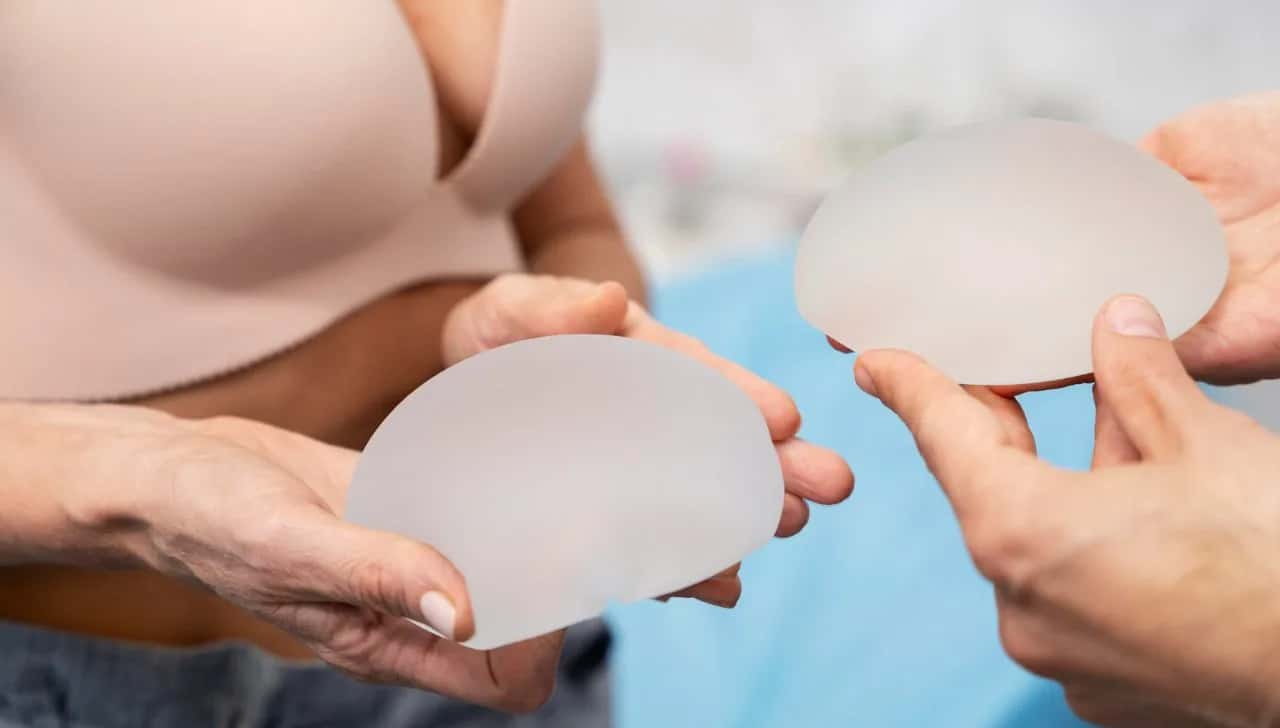


Breast implants are available in different shapes, surfaces, sizes and gel consistencies. These characteristics influence how an implant feels, how much projection it creates and how it behaves inside the breast. Choosing the right one is therefore more complex than selecting a cup size or asking for a specific number of cubic centimetres.
Silicone implants may be used during cosmetic breast augmentation, breast reconstruction or revision surgery. They can restore lost volume, improve asymmetry, rebuild a breast after mastectomy or replace an older implant. However, no implant produces the same result in every person.
Your chest width, existing breast tissue, skin elasticity, nipple position and desired appearance all affect the decision. A qualified plastic surgeon should evaluate these factors before recommending an implant. The best option is usually the one that suits your anatomy and long-term expectations rather than the largest or most heavily advertised model.
What Does “Silicone Implant” Mean?
A silicone breast implant has an outer shell made from silicone elastomer. In a silicone gel implant, this shell contains a soft or cohesive silicone gel.
It is worth noting that saline implants also have a silicone outer shell. The difference is that they are filled with sterile salt water rather than silicone gel. For this reason, the phrase “silicone implant” usually refers specifically to silicone gel-filled models.
Silicone gel implants are popular because their texture can resemble natural breast tissue more closely than saline. They are manufactured in different degrees of firmness, allowing surgeons to choose between softer movement and stronger shape retention.
Implants should not be considered permanent lifetime devices. Complications or natural changes in your body may eventually make further surgery necessary. Common reasons for additional treatment include capsular contracture, rupture, implant movement, asymmetry or a change in personal preference.
Traditional Silicone Gel Implants
Traditional silicone gel implants contain a relatively soft gel that moves within the outer shell. They can create a supple result, particularly when you already have enough natural tissue to cover the implant.
Their softness may be beneficial when natural movement is a priority. However, softer implants may show more rippling in people with thin skin or limited breast tissue.
The final appearance also depends on placement. An implant covered by enough breast tissue or chest muscle may be less visible at the edges. In a person with very little tissue, a firmer implant or different surgical pocket may provide better control.
A soft implant is not automatically more natural. If it is too wide, too large or poorly positioned, it may still look artificial. Shape, dimensions and surgical technique matter as much as gel consistency.
Highly Cohesive Silicone Implants
Highly cohesive implants contain a thicker gel that holds its form more firmly. They are often called form-stable or “gummy bear” implants because the gel tends to remain together rather than flowing freely.
These implants can provide stronger support and more predictable contour. They may be useful when the surgeon needs to shape the lower part of the breast, correct a difficult asymmetry or rebuild the breast after tissue removal.
A highly cohesive implant usually feels firmer than a softer gel model. Whether this is an advantage depends on your goals. Greater firmness may improve shape stability, but it may not suit someone who wants maximum softness and movement.
Some form-stable implants require a slightly longer incision because they cannot be compressed as easily during insertion. They must also be positioned carefully, particularly when they have an anatomical shape.
Moderate-Cohesive Silicone Implants
Between very soft and highly form-stable implants are moderate-cohesive options. These aim to combine softness with enough structure to maintain projection.
They may settle into a natural slope while still providing better shape control than older, softer gel designs. This makes them suitable for a wide range of cosmetic breast procedures.
Implant manufacturers use different names for levels of cohesiveness. One company’s “highly cohesive” model may not feel identical to another company’s implant with a similar label.
Your surgeon should explain the physical differences rather than relying only on product terminology. You may be able to handle sample implants during the consultation, although an implant feels different once it is surrounded by living tissue.
Round Silicone Implants
Round implants are symmetrical. Their upper and lower halves do not have a fixed teardrop orientation, so rotation inside the breast pocket is less likely to create a visible shape problem.
Despite the name, a round implant does not always produce a perfectly round-looking breast. When you stand, gravity and the gel’s behaviour can allow more volume to settle toward the lower part of the breast.
Round implants are available in soft and cohesive varieties. Depending on their profile, they can create subtle fullness or a more prominent upper breast contour.
They are commonly selected for cosmetic augmentation because they offer flexibility and do not depend on one exact rotational position. They may also be used in breast reconstruction.
A round implant can look natural when its width and projection match your body. An oversized implant may create excessive upper fullness, visible edges or stretching, regardless of its shape.
Anatomical or Teardrop Implants
Anatomical implants contain more volume in the lower portion and gradually taper toward the top. Their shape is intended to resemble the natural slope of a breast.
They may be considered when a surgeon needs precise control over breast shape, particularly during reconstruction or correction of certain developmental differences.
Because these implants have a defined upper and lower direction, rotation may distort the appearance. The breast can look unusually wide, uneven or incorrectly shaped if the implant turns inside its pocket.
Many anatomical implants have historically used textured surfaces to reduce movement. However, safety concerns surrounding textured devices have changed how frequently these models are selected in many countries.
An anatomical implant is not automatically more natural than a round one. The result depends on your tissue, implant position and the surgeon’s design. A round implant can produce a gentle slope, while a poorly selected anatomical implant can appear rigid.
Smooth-Surface Silicone Implants
Smooth implants have an outer shell with a relatively even surface. They can move slightly within the surgical pocket, which may allow softer and more natural-looking motion.
They are widely used in modern breast augmentation. Because a round smooth implant has no fixed orientation, small rotational movements usually do not change the breast shape.
Smooth implants may be associated with visible or palpable rippling in people who have thin tissue coverage. Placement beneath part of the chest muscle or using an implant with suitable cohesiveness may reduce this concern, although no method removes it completely.
The surgical pocket must be created accurately. If it is too large, the implant may move downward or sideways. If it is too tight, the breast may appear compressed or unnaturally high.
Textured-Surface Silicone Implants
Textured implants have a rougher outer shell designed to interact with the scar tissue that naturally develops around an implant. This surface was intended to reduce movement and help maintain the position of shaped implants.
Textures vary considerably. Some are lightly textured, while others have a more pronounced surface. These products should not be treated as one identical category.
Textured implants have received increased attention because breast implant-associated anaplastic large cell lymphoma, known as BIA-ALCL, occurs more often in patients with textured implants than in those with smooth devices. BIA-ALCL is a lymphoma that usually develops in the fluid or scar capsule around an implant rather than in breast tissue itself.
The overall risk is considered low, but it is serious enough that implant surface must be discussed openly. Persistent swelling, a new mass, pain or sudden enlargement years after surgery requires medical evaluation.
Textured implants are not routinely removed from symptom-free patients solely because of concern about BIA-ALCL. Your surgeon should consider your exact implant model, symptoms and individual risk before recommending any procedure.
Low-, Moderate- and High-Profile Implants
Implant profile describes how far an implant projects forward relative to the width of its base.
A low-profile implant is generally wider and creates less forward projection. It may suit a broad chest when only modest fullness is wanted.
A moderate-profile implant offers a balance between width and projection. It is frequently considered when the goal is a proportional, noticeable but not extreme result.
A high-profile implant has a narrower base and projects further forward. It may suit a narrower chest or someone seeking more projection without excessive width.
Extra-high profiles are also available. These can create dramatic projection but require sufficient tissue and careful planning. Choosing a high profile simply because it sounds more attractive can lead to an unnatural result if the base width does not match your chest.
Profile cannot be separated from size. Two implants with the same volume may produce very different results when one is wide and low while the other is narrow and highly projected.
Implant Size and Base Width
Breast implant size is often measured in cubic centimetres rather than bra cup sizes. A particular volume does not create the same cup size in every person.
Your starting breast volume, rib-cage shape and skin elasticity influence the result. A 300 cc implant may look modest on one body and relatively large on another.
Base width is one of the most important measurements. The implant should generally fit within the natural width of the breast. An implant that is too wide may extend toward the armpit or bring the breasts unnaturally close together. One that is too narrow may produce excessive central projection with limited side-to-side balance.
Your surgeon may use physical sizers, three-dimensional imaging or temporary samples during the consultation. These tools can support the decision, but none can guarantee an exact postoperative appearance.
Implant Placement Options
The same silicone implant can look and feel different depending on where it is placed.
Subglandular placement positions the implant behind the breast tissue but above the chest muscle. Recovery may be more comfortable, and the implant may move less during chest-muscle contraction. However, its edges and rippling can be more noticeable when natural tissue is thin.
Submuscular or dual-plane placement gives the upper part of the implant additional muscle coverage. This may soften the upper edge and help in patients with limited tissue. It can also cause animation deformity, where the breast changes shape when the chest muscle contracts.
A surgeon may recommend different pockets for reconstructive cases, athletes, patients with sagging or those undergoing revision surgery. Placement should be chosen according to anatomy rather than a universal rule that one position is always better.
Tissue Expanders in Breast Reconstruction
Breast reconstruction may use a temporary tissue expander before a permanent silicone implant is inserted.
An expander resembles a thick silicone balloon. It is placed beneath the skin or chest tissue and gradually filled, usually with saline, to create enough space for reconstruction.
Once the tissues have expanded, a second operation replaces the temporary device with a permanent implant. Expanders are available in different shapes and surfaces and carry risks such as pain, infection, tissue thinning and rupture.
Not every reconstruction requires an expander. Some patients can have a permanent implant placed immediately, while others may be better suited to reconstruction using their own tissue.
What Are the Main Risks of Silicone Implants?
All breast implants carry risks. These include infection, bleeding, scarring, changes in sensation, asymmetry, implant displacement and capsular contracture.
Capsular contracture occurs when the scar tissue around an implant becomes unusually firm and tight. It may distort the breast or cause pain. Severe cases can require further surgery.
Silicone implant rupture may be silent because the implant does not always deflate visibly. The gel may remain inside the shell or move into the surrounding capsule. Ultrasound or MRI may therefore be recommended at intervals to check the implant’s condition.
Rare cancers arising in the capsule around breast implants have also been reported. Any persistent swelling, breast enlargement, new lump, hardening or pain should be assessed, particularly when it develops long after recovery.
How Is the Right Silicone Implant Chosen?
The right implant is selected by combining your expectations with objective anatomical measurements.
Your surgeon should assess:
- Chest and breast width
- Existing breast volume
- Skin thickness and elasticity
- Degree of sagging
- Nipple position
- Differences between the breasts
- Previous surgery or radiotherapy
- Desired projection and upper fullness
A breast lift may be needed when significant sagging is present. A large implant alone does not reliably lift the nipple and may place further stress on the skin.
You should ask for the implant manufacturer, model, surface, shape, profile and size. Keep the device card and surgical records after the procedure. These details are important if you need imaging, develop symptoms or consider revision surgery later.
Conclusion
The main silicone implant types used in breast surgery can be classified by gel consistency, shape, surface and profile. Softer gel implants provide more movement, while highly cohesive implants offer stronger shape stability. Round implants are symmetrical, whereas anatomical implants have a fixed teardrop contour.
Smooth implants are commonly used because they allow natural movement and do not carry the same documented BIA-ALCL association as textured surfaces. Textured implants may provide positional stability in selected cases, but their specific risks require careful discussion.
Implant volume alone should never determine your choice. Base width, projection, tissue coverage and surgical placement all affect the final result.
Breast implants are not permanent lifetime devices, and future monitoring or additional surgery may be necessary. A safe decision requires realistic expectations, an experienced plastic surgeon and a clear understanding of both the benefits and long-term responsibilities involved.
- Last updated
- Language
- English
How did you find this article?
Liposuction has become part of a more open conversation about cosmetic surgery, with celebrities discussing everything from subtle body contouring to difficult recoveries and results they later regretted. These 20 public figures have personally acknowledged undergoing liposuction, offering different perspectives.

Many actors, models, musicians and television personalities have spoken openly about having rhinoplasty, some for cosmetic reasons and others to repair an injury or improve their breathing. This guide looks at what 20 of these celebrities said about their own nose surgery and what their experiences can teach anyone.
Several well-known musicians, reality stars and influencers have spoken openly about having a Brazilian butt lift, and many of them have also shared regret, reduction surgery or difficult recoveries. This guide looks at what these celebrities said about their own procedures and what their experiences can teach anyone.
Subscribe to the Medifinder newsletter and never miss our latest content.