










Ponytail Facelift: The Surgery Behind the Swept-Back Look
Discover how a ponytail facelift works, its recovery, scars, costs, risks and key differences from traditional and deep plane facelifts.

- Last updated
- 51 reads
- 6 min read
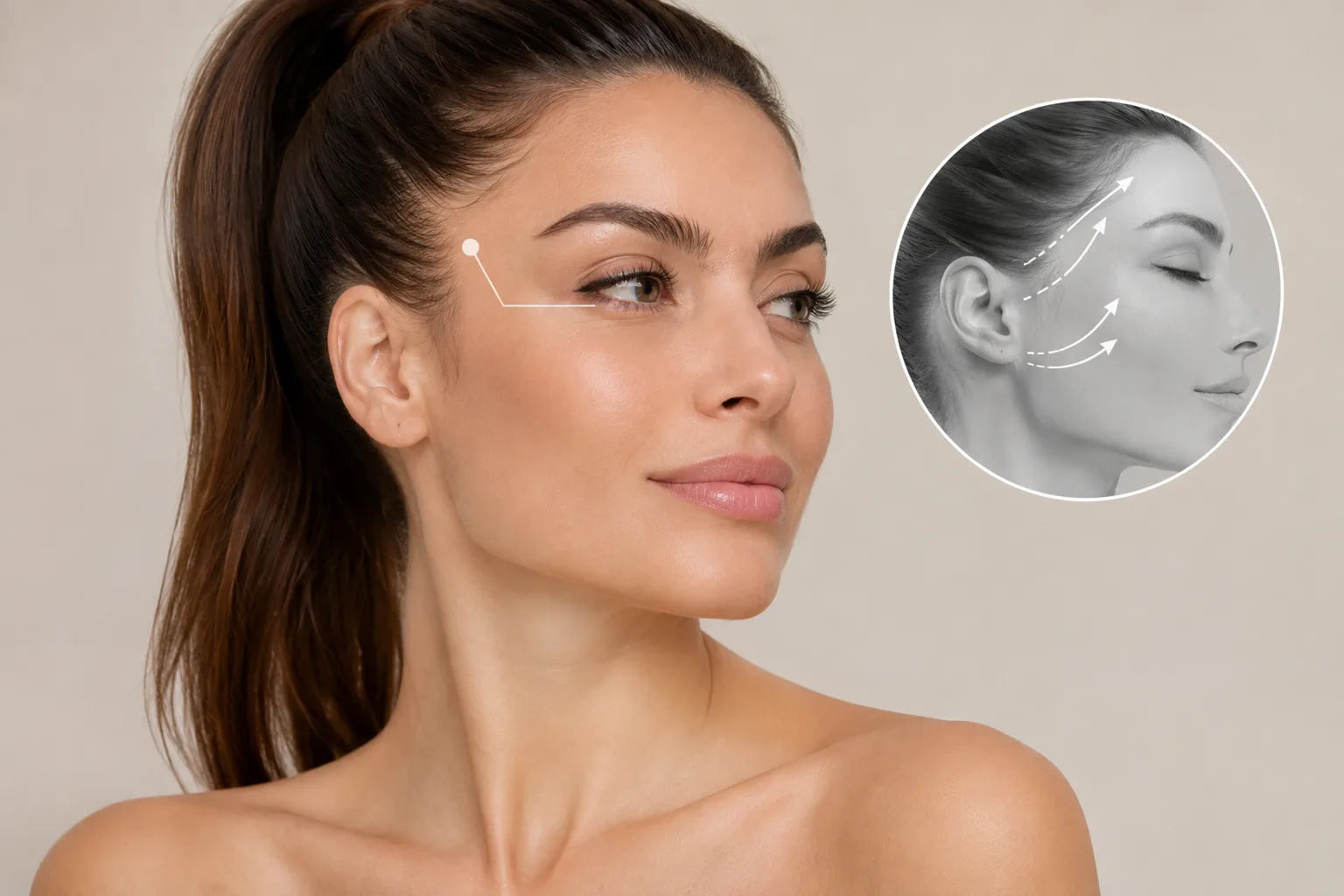


Pulling your hair into a high ponytail can temporarily change the appearance of your face. The cheeks look slightly lifted, the outer eye area appears more defined, and the skin around the temples seems smoother. It is this subtle effect that inspired the name of one of the most talked-about procedures in facial aesthetics: the ponytail facelift.
Unlike traditional approaches to facial rejuvenation, this technique is often associated with discreet incisions and an emphasis on lifting the upper and middle areas of the face. But despite its playful name, it is still a surgical procedure with important limitations, risks and recovery requirements. So, what makes a ponytail facelift different, and can it really recreate that naturally lifted appearance?
What Is a Ponytail Facelift?
A ponytail facelift is a term used to describe certain facial rejuvenation techniques designed to reposition facial tissues in an upward direction, creating an effect similar to pulling the hair into a tight ponytail.
The procedure may focus on the temples, cheeks, outer brow area and midface. Some approaches extend to the lower face and jawline.
One of its distinguishing features is the placement of incisions. Depending on the surgical approach, these may be concealed within the hair-bearing scalp rather than following the more extensive incision pattern associated with conventional facelifts.
However, the ponytail facelift is not a universally standardized surgical technique. Different surgeons may use the term to describe different combinations of endoscopic lifting, deep tissue repositioning and facial rejuvenation procedures.
Why Is the Ponytail Facelift Getting So Much Attention?
Facial aesthetics has gradually shifted towards treatments that aim to preserve individuality rather than dramatically change a person's appearance.
The appeal of the ponytail facelift lies partly in its association with a refreshed, lifted look rather than an obviously tightened face.
Several features contribute to interest in the procedure:
-
Incisions that may be concealed within the hair.
-
An emphasis on lifting the cheeks and temples.
-
Potential improvements in selected areas with early facial tissue descent.
-
An approach that may avoid some of the visible incision patterns of conventional facelifts.
-
The possibility of repositioning facial tissues rather than relying on repeated filler injections.
Social media has also made the swept-back aesthetic more recognizable. However, photographs of celebrities with lifted cheeks or defined eyes should not be interpreted as evidence that they have undergone this particular operation.
How Does a Ponytail Facelift Work?
Rather than simply pulling the skin tighter, many ponytail facelift techniques involve repositioning tissues beneath the skin.
The surgeon may use an endoscope, a small surgical camera that allows internal structures to be visualized through relatively small incisions.
Selected tissues are released, repositioned and secured to create a lifting effect. Depending on the surgical plan, treatment may also involve the brow, temples or deeper cheek tissues.
Some procedures combine endoscopic techniques with deep plane dissection, while others use different tissue-lifting methods.
The extent of the operation determines whether general anaesthesia or another anaesthetic approach is appropriate.
Despite the smaller incisions associated with some techniques, a ponytail facelift should not be confused with a non-surgical treatment or a simple cosmetic injection.
Ponytail Facelift vs Deep Plane Facelift: How Are They Different?
The distinction between these procedures is not always as straightforward as their names suggest.
A ponytail facelift generally describes a lifting concept and, in some approaches, a particular incision strategy. A deep plane facelift describes the anatomical layer in which the surgeon operates.
This means that some ponytail facelift procedures may incorporate deep plane techniques.
| Feature | Ponytail facelift | Deep plane facelift |
|---|---|---|
| Main focus | Often the temples, cheeks and midface | Midface, lower face and jawline |
| Incisions | May be concealed within the scalp | Typically around the ears and hairline |
| Surgical technique | May incorporate endoscopic methods | Repositioning deeper facial tissues |
| Excess skin | May be less suitable for substantial skin excess | Can address more extensive skin laxity |
| Recovery | Depends on the extent of surgery | Generally several weeks of visible healing |
Neither procedure is automatically better. The amount of loose skin, facial anatomy and desired outcome all influence surgical suitability.
For a closer look at deeper tissue repositioning, read our guide to the deep plane facelift, its benefits, recovery and risks.
Who Is a Good Candidate for a Ponytail Facelift?
The procedure may appeal to adults who have noticed early or moderate changes in facial contours but do not necessarily require extensive skin removal.
Potential candidates may experience:
-
Mild to moderate cheek sagging.
-
Loss of definition around the midface.
-
Descending tissues around the temples or outer brow.
-
Early changes in facial contours.
-
Relatively good skin elasticity.
People with significant loose skin around the jawline or neck may benefit more from another facelift technique that allows excess skin to be removed.
Age alone does not determine whether someone is a suitable candidate. Medical history, previous cosmetic procedures, skin quality and realistic expectations are equally important.
Does a Ponytail Facelift Really Leave No Scars?
The possibility of avoiding visible scars is one of the procedure's biggest attractions. However, describing it as a scarless facelift can be misleading.
Every surgical incision creates a scar.
In certain ponytail facelift techniques, incisions are placed within the scalp, where surrounding hair may help conceal them once healing is complete.
Although this approach can make scars less noticeable, it does not eliminate the possibility of visible scarring, temporary hair loss, permanent hair thinning around incision sites or changes in the hairline.
These considerations are particularly relevant for people with thinning hair or a naturally high hairline.
Ponytail Facelift Recovery: From the First Week to Final Results
Recovery depends largely on the extent of tissue repositioning and whether additional procedures are performed.
During the first week, swelling, bruising, tightness and temporary changes in sensation may occur. The facial contours may look different from the anticipated final result.
During weeks two and three, visible swelling and bruising often begin to improve. Some patients may feel comfortable returning to desk-based work or social activities.
Over the following months, deeper tissues continue to heal, residual swelling settles and facial contours gradually become more established.
Smaller incisions do not necessarily mean a shorter recovery. Internal tissue healing remains an important part of the process, even when surgical scars are relatively well concealed.
How Long Does a Ponytail Facelift Last?
A ponytail facelift can produce improvements that remain visible for several years. However, there is no universally established lifespan for its results.
Factors influencing longevity include skin elasticity, the surgical technique, sun exposure, weight fluctuations, smoking and the natural ageing process.
The procedure does not stop facial ageing. Skin and deeper tissues will continue to change over time.
Claims that a particular facelift guarantees a youthful appearance for a fixed number of years should therefore be approached with caution.
What Are the Risks of a Ponytail Facelift?
Despite its association with discreet incisions and subtle rejuvenation, the ponytail facelift carries surgical risks.
Possible complications include:
-
Bleeding, hematoma and infection.
-
Temporary or permanent facial nerve injury.
-
Facial asymmetry or excessive lifting.
-
Hair loss around incision sites.
-
Poor wound healing and visible scars.
-
Anaesthesia-related complications.
-
Dissatisfaction with the final appearance.
Because the procedure may involve structures around the temples, facial nerves and deeper cheek tissues, appropriate surgical training and anatomical knowledge are particularly important.
How Much Does a Ponytail Facelift Cost?
Ponytail facelift pricing can vary considerably because the term may describe several different surgical approaches.
The final quotation may include the surgeon's fee, anaesthesia, operating facilities, endoscopic equipment, postoperative care and additional procedures such as a brow lift or neck lift.
A limited endoscopic lifting procedure should not be directly compared with a comprehensive facial rejuvenation operation simply because both are marketed as ponytail facelifts.
For international pricing benchmarks and an overview of the factors that influence facial rejuvenation costs, explore MediFinder's Deep Plane Facelift Costs Around the World: 2027 Country-by-Country Guide.
Beyond the Trend: Is a Ponytail Facelift Worth Considering?
The ponytail facelift reflects a growing interest in facial rejuvenation that preserves natural features while addressing changes in facial contours.
For appropriately selected patients, the technique may offer meaningful improvements, particularly around the temples and cheeks. For others, a conventional facelift, brow lift or combined surgical approach may better address their concerns.
The most important question is not whether a procedure can recreate a particular beauty trend, but whether it can safely achieve a result that suits your individual facial anatomy.
Before deciding on a facelift, take time to understand the exact surgical technique, the expected recovery, the potential complications and the qualifications of the surgeon performing it.
- Last updated
- Language
- English
How did you find this article?

Choosing a plastic surgery clinic? Learn seven warning signs to look out for before booking your procedure, at home or abroad.

Why is the deep plane facelift getting so much attention? Explore how it works, recovery, results and what makes it different.

A seroma after tummy tuck can cause soft swelling or a fluid pocket. Learn the symptoms, causes, diagnosis, treatment options, and warning signs.
Subscribe to the Medifinder newsletter and never miss our latest content.