










Why Do I See a Shadow After Cataract Surgery?
A shadow after cataract surgery may come from lens optics, dry eye, floaters, or retinal changes. Learn what patterns matter and when urgent care is needed.

- Last updated
- 8 reads
- 7 min read
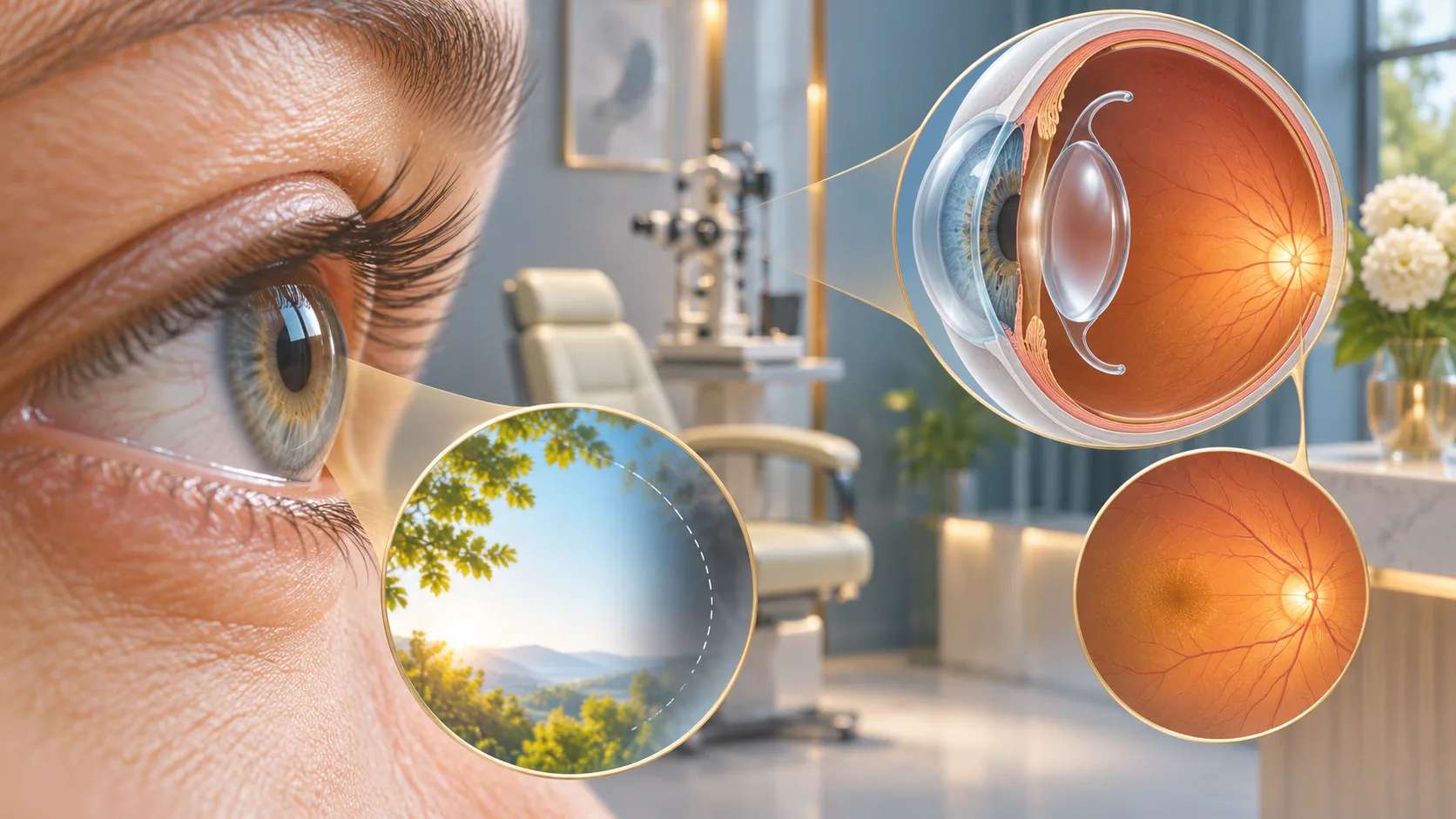


Seeing a shadow after cataract surgery can be unsettling, particularly when the rest of the vision seems clearer. The shadow may look like a dark edge, a crescent, a smudge, or a moving shape near the side of the image. Some causes are temporary optical effects during healing, while others involve the retina, lens capsule, or the eye surface and deserve a closer examination.
What Does a Shadow After Cataract Surgery Look Like?
People describe shadows in different ways. A dark crescent may appear at the edge of vision, a grey patch may move when the eye moves, or a faint double contour may appear beside objects. It can be present in bright rooms, outdoors, or mainly against a plain background.
Note whether the shadow stays in the same location, moves with your gaze, changes after blinking, or appears only with certain lighting. These details help distinguish an optical effect from a new disturbance in the visual field.
Common Reasons for a Shadow After Surgery
Negative Dysphotopsia
A dark arc or crescent near the outer edge of vision can occur when light interacts with the edge of the artificial lens and the surrounding structures. This optical effect is often called negative dysphotopsia. It may be most noticeable in bright settings or when looking at a plain wall.
Positive Dysphotopsia
Bright streaks, arcs, or reflections around lights are a different optical effect. They can coexist with a shadow and may become less noticeable as the brain adapts to the new lens.
Dry Eye and Surface Irregularity
An unstable tear film can create a ghost image or soft shadow beside objects. If the effect clears briefly after blinking, the eye surface may be contributing. Dryness often fluctuates with screens, wind, heating, and fatigue.
Posterior Capsule Opacification
The thin membrane behind the artificial lens can become cloudy later. This may create haze, glare, reduced contrast, and a general feeling that a veil has returned. It is different from a sharply defined missing area in the visual field.
Floaters and Vitreous Changes
Small clumps in the gel inside the eye can cast shadows on the retina. Floaters may look like threads, dots, cobwebs, or moving spots. A sudden increase in floaters is more important than a stable floater noticed occasionally.
Retinal Problems
A curtain, fixed dark patch, flashing lights, or a rapidly expanding shadow can signal a retinal tear or detachment. These symptoms require urgent assessment because early treatment can protect vision.
- A crescent at the edge of vision may be an optical lens effect.
- A shadow that moves with the eye may come from a floater.
- A fixed curtain or missing area is more concerning.
- Sudden flashes and many new floaters need urgent care.
Can a Shadow Be Part of Normal Healing?
During the first days or weeks, swelling, tear film changes, and the brain’s adjustment to the artificial lens can make vision feel unusual. A mild peripheral crescent that is stable and not associated with pain or vision loss may become less noticeable as healing progresses.
Normal adaptation should not be used to explain away a symptom that is suddenly worse, fixed in place, or accompanied by flashes and missing vision. The timing and behaviour of the shadow matter more than the word used to describe it.
Why the Brain May Notice the Shadow Less Over Time
The visual system learns to filter repetitive optical signals. As the new lens becomes familiar, a faint edge effect may attract less attention. This is not the same as ignoring a retinal warning sign. A symptom that changes character, spreads, or affects central vision should still be checked.
When Should You Seek Prompt Eye Care?
Contact the eye care team promptly for a new or worsening shadow, reduced vision, increasing pain, marked redness, discharge, or strong light sensitivity. A shadow that stays fixed in one part of the field deserves assessment even if it is not painful.
Seek urgent care for a curtain-like shadow, sudden loss of vision, new flashes, a sudden shower of floaters, severe headache with nausea, or a painful red eye. Do not drive yourself if the visual field is unreliable.
- Sudden onset or rapid expansion of the shadow.
- Flashes of light or many new floaters.
- Loss of side vision or a curtain effect.
- Severe pain, redness, or a sudden drop in sharpness.
How the Cause Is Evaluated
An eye examination may include visual acuity, eye pressure, slit lamp inspection, pupil assessment, and a dilated retinal examination. The artificial lens, capsule, cornea, and vitreous are checked separately. Imaging may be used when the retina or macula needs a closer look.
Describe whether the shadow is central or peripheral, fixed or moving, and whether it appears with one eye closed. Bring a timeline of when it began, any recent medication changes, and associated flashes, floaters, pain, or distortion.
What Treatments May Be Considered?
Surface related shadows may improve when dryness and eyelid inflammation are treated. Capsule clouding can often be addressed with a laser procedure when it is the cause of reduced clarity. Optical edge effects may become less noticeable through adaptation, although persistent symptoms require a careful review.
Retinal tears, detachment, infection, or significant inflammation require condition specific treatment and should not be managed with over the counter drops alone. The treatment decision depends on what the examination shows, not simply on how dark the shadow appears.
Practical Steps While Waiting for Review
Protect the eye from rubbing and accidental impact. Use prescribed drops as directed, avoid unapproved medication, and note the symptom under consistent lighting. If the shadow affects walking, reading, or driving, stop those activities until vision is reliable.
- Check each eye separately for a few seconds without pressing on it.
- Write down the time and setting when the shadow appears.
- Avoid rubbing or repeatedly testing the eye.
- Keep follow-up appointments even when the symptom is mild.
Frequently Asked Questions About Shadows After Cataract Surgery
Is it normal to see a shadow after cataract surgery?
A mild peripheral crescent can occur as the eye adapts to the artificial lens, but a fixed or worsening shadow needs an examination to rule out retinal and other causes.
What does a dark crescent in the side vision mean?
It may be an optical edge effect called negative dysphotopsia, especially when it appears in bright light. A new fixed dark area should still be assessed.
Can floaters look like shadows after surgery?
Yes. Floaters can cast moving shadows or appear as dots and threads. A sudden increase, especially with flashes, requires urgent care.
Can dry eye cause a shadow or ghost image?
An unstable tear film can create blur or a faint duplicate image that changes after blinking. Persistent or worsening symptoms should not be assumed to be dryness.
When is a shadow an emergency?
A curtain effect, sudden vision loss, new flashes, many new floaters, severe pain, or a rapidly expanding shadow requires urgent eye care.
Taking a New Visual Symptom Seriously
A shadow after cataract surgery may be a temporary optical effect, a surface problem, a floater, or a sign of a retinal issue. The safest approach is to observe its pattern, protect the eye, and seek timely assessment when it is new, fixed, or changing. Clear information about timing and associated symptoms helps the examination focus on the right structure.
Lighting can make a shadow seem to appear and disappear. Bright windows, a plain white wall, and strong contrast reveal optical effects that are harder to notice outdoors or in a dim room. Compare the symptom with one eye covered briefly, but do not press on the eyelid or stare at a bright light to provoke it.
Some people notice a peripheral crescent when they move from a dark room into daylight. Others see a haze after reading or using a screen because blinking slows and the tear film breaks up. These patterns are useful clues, yet they do not replace a retinal examination when the symptom is new.
Do not use an internet image or an edited photograph to decide whether the retina is safe. The retina can be affected even when the front of the eye looks quiet. A sudden change in side vision deserves the same seriousness as a sudden drop in central sharpness.
Keep medication bottles and postoperative instructions nearby when calling for advice. Mention whether the operation was recent, whether the symptom is in one eye, and whether the shadow is moving or fixed. Precise descriptions help the team decide how quickly you need to be seen.
Until the cause is clear, avoid night driving and activities that depend on a complete visual field. Ask someone else to transport you if urgent review is recommended. Safety is more important than waiting to see whether the shadow fades on its own.
- Last updated
- Language
- English
How did you find this article?

Dry eyes after LASIK often improve gradually as corneal nerves and the tear film recover. Learn what affects the timeline, what helps, and which warning signs need care.
Halos after cataract surgery can reflect healing, dry eye, corneal swelling, or lens adaptation. Learn what helps, what to monitor, and when to seek care.
Blurred vision weeks after cataract surgery can have several causes. Learn what may be happening, what to watch for, and when prompt eye care is needed.
Subscribe to the Medifinder newsletter and never miss our latest content.